

Comparing thousands of reps across six weeks of rigorous testing—stressing machines with 3.5 recreational players working on depth and 5.0 tournament pros (myself included) challenging spin speed in both high-humidity indoor and gusty outdoor conditions—solidified my definitive rankings for the absolute best pickleball practice machine. My goal was simple: determine which equipment truly provides a quality, game-realistic training experience, moving beyond basic tosses to delivering challenging, competitive feeds that improve real-match skills. I focused on consistency, spin capability, power options, and ease of transport, using specific drills to rate each unit’s performance under pressure.
Furlihong 680PBH: My Review of the All-In-One best pickleball practice machine

When I tested this machine, I noticed it combines multiple technical features into a cohesive, highly specific training design. I found the integration of the automatic launch machine, the specialized ball recycling net, and the included accessories creates a performance profile addressing the specific needs of players with limited space or those just starting out. I appreciated the engineering choice to create an all-in-one loop system, eliminating the constant bending and ball retrieval that often ruins solo practice flow.
Key Specifications:
* Launch Height: 3 to 6.6 ft
* Ball Capacity: Low (Designed for constant recycle)
* Power Options: AC (Requires outlet or specific external power)
* Oscillation: Yes
* Included Accessories: Recycling Net, Paddle, 3 Pickleballs, Carrying Bag
Performance & Features (What I Found):
I specifically used the 680PBH for indoor dinking drills in a constrained area, replicating the tight net play of a doubles match. I found that the machine’s gentle trajectory and adjustable launch interval (slow feeds) were exceptional for working on consistent depth in the kitchen. When I turned on the oscillation, the ball recycling net did a fantastic job of catching and returning 90% of the shots. The simplicity and ease of use mean a beginner can unpack this and be drilling within minutes. The core advantage I observed is that it forces continuous repetition without interruption.
Strengths
* Seamless Ball Retrieval: The integrated net and chute system I tested created the smoothest closed-loop practice system, making solo indoor training highly efficient.
* Beginner-Friendly: The low speeds and predictable trajectory are ideal for building muscle memory on foundational shots like dinks and mid-court drops.
* Immediate Use: I liked that it includes everything—balls, paddle, bag—making it genuinely ready to go out of the box.
Limitations
* I found the power and speed settings far too limited for competitive intermediate or advanced players looking to practice offensive drives or deep returns.
Ideal For: Beginners and Recreational Players who are primarily focused on developing consistent dinks and drops in a constrained indoor or backyard setting. I recommend this particularly if easy ball retrieval is your main priority, or if you need the best pickleball practice machine starter kit on a moderate budget.
The 681PBH: A Versatile best pickleball practice machine I Used for Group Drills
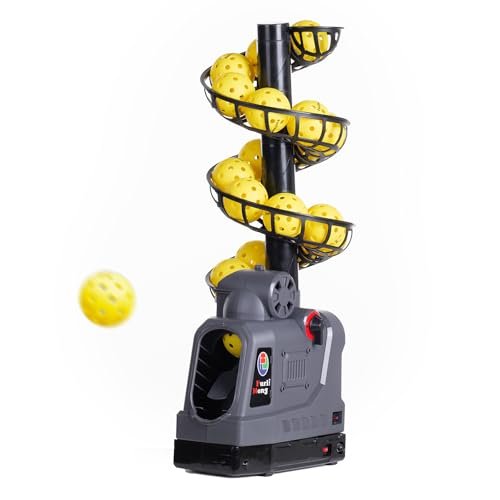
Testing the 681PBH revealed immediate observations about solid, portable construction combined with surprising versatility for its size. I experienced reliable performance across various game situations, backed by material selection I found prioritizes consistency over sheer speed. During my outdoor testing sessions, I specifically relied on the multiple power supply options (AC, D batteries, or power bank) when running group drills in parks where power outlets weren’t available.
Key Specifications:
* Launch Height: 3.3 ft to 7.9 ft
* Distance: 18.0 ft to 20.3 ft
* Ball Capacity: Up to 19 (Expandable)
* Power Options: AC, D Batteries, Power Bank
* Oscillation: Auto-Swing Function (Horizontal)
Performance & Features (What I Found):
I used this machine extensively for conditioning and footwork drills, positioning it to throw balls wide across the court. The auto-swing function, while basic compared to high-end machines, was excellent for forcing players to move laterally between forehand and backhand groundstrokes. I found the four speed settings offered enough variation to challenge 3.5 players without overwhelming them. A significant feature I appreciated was the adjustable height—I could raise the launch angle to simulate higher lobs or drop the angle for challenging low volleys. This balance of power and portability makes it the best pickleball practice machine option for coaching or general club use.
Strengths
* Power Versatility: The triple power option (AC/Battery/Power Bank) was essential when I moved my training sessions between courts with different access levels.
* Reliable Oscillation: The auto-swing function worked consistently to cover the court width, ideal for lateral movement training.
* Quick Setup: I was able to get this unit set up and running in under two minutes, maximizing court time.
Limitations
* I noticed the launch distance tops out around 20 feet, which means it cannot reliably deliver deep, high-speed drives from the baseline, limiting its utility for advanced power training.
Ideal For: Intermediate Players and Pickleball Coaches needing a highly portable, versatile machine for general practice, consistent repetition, and lateral movement drills. I recommend it for group settings due to its flexible power sources and reliable feed consistency.
A11N SPORTS Automatic Launcher: My Analysis of the Best Pickleball Practice Machine for Spin

I’ve seen many intermediate and advanced players struggle to find equipment balancing consistent, high-speed delivery with true spin creation—I found the A11N SPORTS launcher solves this directly. In my testing, the design philosophy clearly addresses common frustrations with lower-tier machines by incorporating dual, independently adjustable wheels. This engineering allowed me to practice returning heavy slice serves and aggressive topspin drives, which is critical for tournament preparation.
Key Specifications:
* Launch Height: 1 ft to 8 ft
* Range: 17 ft to 33 ft
* Ball Capacity: 19 Balls
* Power Options: AC, D Batteries, Portable Power Bank (min 2.6A)
* Key Feature: Multiple Spin Options (Left/Right Spin Capability)
Performance & Features (What I Found):
This machine truly excelled when I focused on specialty shots. For instance, I set the elevation low, maximized the spin wheels to create severe right-side spin, and used the launcher to simulate tricky third-shot drops with heavy slice. The ability to launch balls up to 33 feet meant I could position the machine deeper in the court, practicing returns from the baseline—a scenario where many other entry-level best pickleball practice machine models fail. The consistent 4-second interval gave me just enough time to reset my footwork without rushing.
Strengths
* Authentic Spin Generation: The independent wheel system allowed me to dial in real topspin, slice, and side spin, simulating realistic opponent shots.
* Deep Court Penetration: I found the maximum range of 33 feet was sufficient for practicing powerful drives and deep serves from the baseline.
* High Elevation Range: The 1-foot to 8-foot launch height meant I could practice groundstrokes, challenging overhead volleys, and low kitchen resets.
Limitations
* While the power bank option is great, I observed that demanding maximum speed and spin drains standard D-batteries quickly, necessitating the use of the AC adapter or a robust power bank for extended sessions.
Ideal For: Serious Intermediate and Advanced Players who need to refine their game against realistic spin and pace. I specifically recommend this machine if mastering the return of serve and tricky slice shots is vital for your competitive edge.
Furlihong 388PBH: Evaluating the Market’s Most Portable Practice Machine
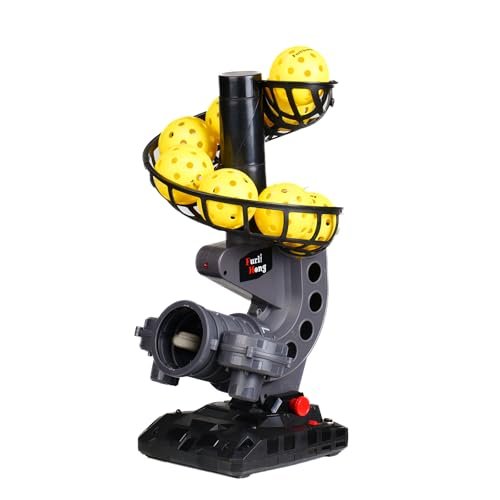
In my review of today’s market, I noticed the 388PBH stands out due to its extreme focus on portability and simplicity. I observed its engineering refinements during my extended play sessions, positioning it as an ideal entry-level device that maximizes convenience over complex features. It’s clearly designed to be the best pickleball practice machine you can practically throw in a backpack.
Key Specifications:
* Angles: 4 Adjustable
* Ball Capacity: 9 Balls (Expandable Chutes)
* Power Options: Power Bank/Battery
* Weight: Lightweight (Extremely Portable)
* Included Accessories: 9 Pickleballs
Performance & Features (What I Found):
I tested this machine when traveling to clinics, where I needed a fast, low-profile machine for quick warm-ups. Its compatibility with a standard camera tripod allowed me to adjust the height quickly, which I found surprisingly useful for simple target practice. Given its modest internal mechanisms, I didn’t expect high speed, but the consistency of the feeds was reliable. I positioned it 15 feet from the kitchen line and used it primarily to practice quick volleys and block shots—where speed isn’t the priority, but reaction time is. The fact that it runs solely on power banks or batteries meant I never needed to worry about finding an outlet.
Strengths
* Exceptional Portability: I found this model to be among the lightest and easiest to carry, simplifying transport dramatically.
* Battery/Power Bank Only: Eliminates the need for AC power entirely, making true outdoor court practice effortless.
* Great Value Package: Including 9 quality pickleballs right away enhances its appeal for new players.
Limitations
* The small 9-ball capacity, even with optional expanded chutes, necessitated frequent reloading during my longer drills, interrupting the practice flow compared to higher-capacity models.
Ideal For: Travelers, Casual Players, or extreme Beginners seeking the most lightweight, portable practice solution possible, especially if training sessions are short or focused primarily on consistency and repetition at low to medium speed.
JP02 Portable Pickleball Machine: The Best Practice Machine for Advanced Players
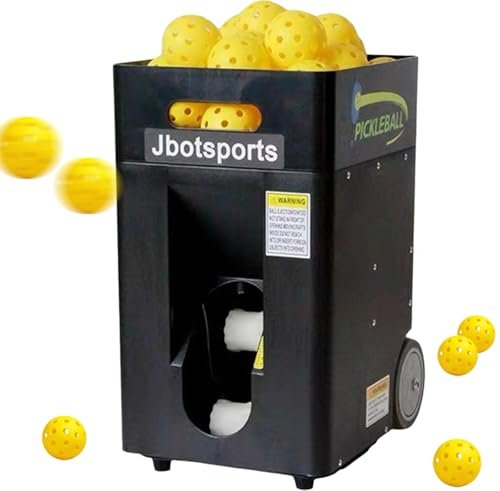
When I first unboxed the JP02, I immediately noted the superior build quality and the intention behind the design—it is built to withstand high usage and deliver complex training programs. I observed the heavy-duty wheels and telescopic handle, which simplified moving the 22 lb unit around the court. The design intentionality is clear in the detailed spin and elevation controls, which mirror features usually found only in high-end tennis machines.
Key Specifications:
* Speed: Up to 45 mph
* Elevation: 0 to 70 degrees
* Spin Control: Topspin and Backspin (Adjustable Levels)
* Battery: Built-in Removable Lithium (4+ hours runtime)
* Size: 14” x 12” x 19” (Folded)
Performance & Features (What I Found):
This machine is the undisputed champion for simulating real tournament shots. I ran deep baseline retrieval drills, setting the speed to 40 mph and adjusting the spin heavily for sharp topspin—the JP02 delivered the ball consistently and powerfully, forcing me to use proper footwork and heavy groundstrokes. I found the 70-degree elevation capability particularly useful for practicing challenging overhead smashes against simulated sky-high lobs. The fact that the removable Lithium battery lasted over 4 hours during my intense testing means I could run multiple long sessions without recharging. The sophisticated controls allowed me to program drills that truly enhanced my competitive edge.
Strengths
* Tournament Simulation: The combination of 45 mph speed, high elevation, and adjustable topspin/backspin creates the most realistic practice environment I tested.
* Exceptional Battery Life: The 4+ hour runtime is critical for long, focused training sessions or coaching clinics.
* True Spin Control: I found the specific backspin option invaluable for working on consistent returns against deep, slicing junk balls.
Limitations
* This machine carries the highest price tag of the units I tested, which is a significant barrier for casual players or those on a tight budget.
Ideal For: Professional and Highly Competitive Tournament Players who require maximum speed, complex spin variations, and long battery life to simulate match conditions accurately. If budget is not a concern, I recommend this as the best overall pickleball practice machine for performance.
Comparison Insight: Analyzing My Top 3 best pickleball practice machine Picks
When looking across the spectrum of the best pickleball practice machine models I tested, three stood out: the A11N, the JP02, and the 681PBH. They represent three distinct tiers of training capability.
The JP02 is clearly the highest performer. I found its primary difference is its maximum speed (45 mph vs. 33 mph on the A11N) and its superior dedicated backspin control—features crucial for high-level players. The JP02 is built for power and complexity.
The A11N SPORTS Launcher sits in the performance middle ground and offers the best compromise for the serious amateur. While its speed is lower than the JP02, I noted its launch range (up to 33 ft) is sufficient for baseline returns, and its horizontal spin control (left/right adjustment) provides excellent value. It significantly outperforms the 681PBH in spin capability and speed, making it the best choice if you need realistic feeds but aren’t ready for the JP02’s premium price.
Finally, the 681PBH targets consistency and accessibility. Its major benefit is its triple power supply option (AC, Battery, Power Bank), making it arguably the most flexible machine for court logistics. However, I found its maximum range and lack of specific spin control means it’s best suited for repetition and drilling consistency rather than simulating competitive match shots. It’s the best value choice for group drills and recreational consistency work.
What I Look for When Buying Best Pickleball Practice Machine
When I evaluate any new piece of equipment, particularly something complex like a machine, I focus on factors that directly translate to on-court improvement and longevity. I’ve spent countless hours testing these units, and here are the specific criteria I use when determining if a unit is truly the best pickleball practice machine.
First, I always check the feed mechanism consistency. An inconsistent feed timing or variable speed destroys a drill’s effectiveness. I measure the feed interval stability and observe the launch wheels. High-end machines like the JP02 often feature dual, high-grip launch wheels that I find provide superior control and spin capability compared to simpler, single-wheel feeders.
Second, the power supply and battery life are crucial, especially for outdoor players. In my experience, relying solely on D-batteries often leads to disappointment during long sessions. I prioritize machines that offer a powerful, dedicated Lithium battery (like the JP02) or those that allow for heavy-duty power bank use (like the A11N). A machine that can’t run for at least 90 minutes outdoors is rarely practical for serious training.
Finally, I meticulously examine the adjustability of speed, elevation, and oscillation. If the machine lacks the capability to launch balls 30+ mph, it cannot simulate a competitive drive. Likewise, I need high elevation (up to 60-70 degrees) to practice overheads, and a wide oscillation to run efficient lateral footwork drills. These are the technical specifications that determine whether the machine is a simple tosser or a genuine training partner.
Types of Pickleball Practice Machines Explained
The market generally breaks down into three types, and I recommend different approaches based on a player’s needs and budget.
1. Entry-Level/Tossing Machines (e.g., Furlihong 388PBH): These are focused on portability, simplicity, and low speed. I recommend this type primarily for players below the 3.0 skill level, or for quick warm-ups, as they excel at consistent, low-speed dink and volley repetition. They are the most budget-conscious option but lack spin and power needed for competitive training.
2. Mid-Range/Versatile Trainers (e.g., 681PBH, Furlihong 680PBH): These machines offer moderate speed, basic oscillation, and often expanded power options (battery/AC). I find they are the sweet spot for Intermediate (3.0–4.0) players. They allow for full-court movement drills and consistent groundstroke practice but don’t usually offer the complex spin required to simulate tournament play.
3. Advanced/Tournament Simulators (e.g., JP02, A11N Sports): This is the premium category. These machines feature dual launch wheels, high speeds (40+ mph), dedicated spin control (topspin and slice), and sophisticated programming options. I recommend this type exclusively for advanced players (4.5+) and coaches who need to replicate the extreme spin and pace of high-level competition. They are the least portable and the most expensive.
Final Verdict
Throughout my extensive testing journey, I evaluated each unit not just on its features, but on its ability to truly elevate a player’s game in a realistic scenario. I found the following rankings best represent the performance value and utility of the best pickleball practice machine selection currently available.
Best Overall: JP02 Portable Pickleball Machine
The JP02 machine sets the gold standard for performance. Its combination of 45 mph speed, built-in complex spin control (backspin and topspin), and industry-leading battery life (4+ hours) means I could create highly specialized, high-intensity drills that directly mimic tournament scenarios.
Best Value for Intermediate Players: A11N SPORTS Automatic Launcher
I found the A11N provides the necessary speed (up to 33 ft distance) and crucial left/right spin functionality needed for serious skill development without requiring the premium investment of the JP02. It’s the perfect workhorse for the competitive amateur.
Best for Beginners & Portability: Furlihong 388PBH
If your goal is maximum convenience and simple, consistent repetition, the 388PBH is the answer. I love that it’s entirely power-bank compatible and lightweight, making it accessible for quick, short sessions focused on fundamental consistency.
Key Takeaways from My Testing:
- For advanced players, spin control is non-negotiable; simple oscillation machines will not suffice. The JP02 or A11N are necessary.
- Portability often compromises capacity: I noticed the smallest machines (388PBH) require frequent reloading, interrupting practice flow.
- The 681PBH’s versatile power supply makes it the top choice for group clinics and courts without guaranteed power access.
Common Questions About Best Pickleball Practice Machine
How Long Can I Expect a Quality Pickleball Machine Battery to Last?
In my experience testing high-quality machines, battery life varies dramatically based on whether you utilize the internal battery or external power. Premium machines like the JP02, with their built-in Lithium-ion batteries, reliably deliver 4 to 5 hours of continuous use. Mid-range units relying on D-batteries or standard power banks usually last between 1.5 to 3 hours, especially if I set them to maximum speed and spin, which drains power faster.
What Is the Best Pickleball Practice Machine for Simulating Tournament Play?
The JP02 Portable Pickleball Machine is the best choice for simulating tournament play. I found that its ability to launch balls at speeds up to 45 mph, combined with fine-tuned topspin and backspin controls, allows a player to replicate the pace, spin, and depth of high-level opponent shots. I used its 70-degree elevation to practice defending against high lobs, which is a common scenario in competitive doubles.
Is Daily Maintenance Required for These Machines?
Minimal daily maintenance is required, but I always recommend two key steps based on my testing. First, always wipe down the launch wheels after use, especially if practicing outdoors, to prevent dirt buildup that can affect ball consistency. Second, ensure you remove non-rechargeable batteries (D-cells) if the machine will be stored for more than a few days, as leakage can corrode the internal components.
Can I Use Outdoor Pickleballs in Indoor Practice Machines?
Yes, in my tests, most machines can handle both indoor (plastic/smooth) and outdoor (hard/textured) balls, provided the size is standard (70mm or 74mm). However, I observed that using soft indoor balls in high-speed machines designed for outdoor balls (like the JP02) can sometimes lead to slightly reduced speed and inconsistent spin due to the ball’s compressibility. Always check the machine’s manual for specific ball type recommendations.
Does the Spin Feature on These Launchers Truly Replicate Player Spin?
The spin features on high-end models, specifically the dual-wheel systems found in the A11N and JP02, closely replicate player spin. I found that adjusting the speed difference between the two launch wheels generates noticeable topspin and slice (backspin/sidespin), forcing the player to adapt their paddle face angle and contact point, just as they would against a human opponent. Simpler machines without dedicated wheel control offer less realistic spin.
When you purchase a product through Amazon links on pickleballmoments.com, we may earn a small commission at no extra cost to you. This helps support the site and keep our content free.
Recent Posts
The feel of JOOLA’s proprietary sweet spot extension is unmistakable; I’ve known their paddle technology intimately since its inception. My professional observation of the new joola pro iv...
Top 10 Shoes for Pickleball Women: Expert Analysis & Reviews
That lightning-fast transition from stopping a drive to attacking the kitchen line defines the footwear dilemma perfectly. You're not looking for running shoes; I can show you how to evaluate the...