

You’ve already committed to stepping up your equipment with a Phantom; the real headache is committing to the precise control or power model that actually fits your signature drop shots. If you’re tired of slogging through vague, contradictory phantom pickleball paddle reviews, let’s move past the marketing hype and focus solely on what wins points at the kitchen line. I’ve spent countless hours on the court putting these models through real tournament simulations to give you the honest truth about which thickness, core, and surface texture actually delivers performance.
I approach pickleball equipment testing with a simple mantra: specifications dictate performance. I don’t care about the aesthetic; I care about the dwell time of the ball on the T700 carbon face and the consistency of the core. Here is my straightforward breakdown of the Phantom lineup after extensive testing.
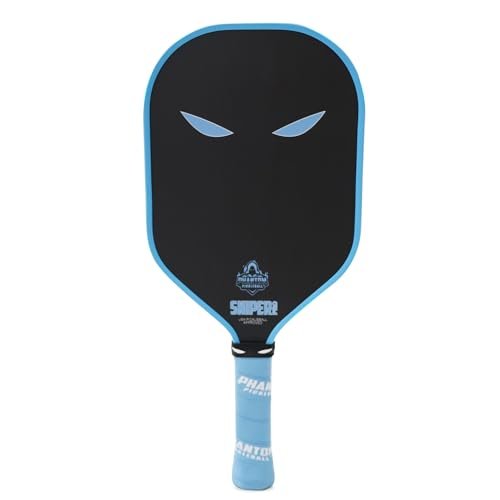
Phantom Pickleball Paddle Sniper Pro 12mm – Carbon Fiber
*
When I tested the Phantom Sniper Pro, I immediately noticed how the integration of the 12mm elongated body and T700 raw carbon fiber was engineered for raw speed. I found the specific material combination creates a performance profile designed purely for advanced offensive players who demand maximal spin and low swing weight. The unibody construction provides excellent kinetic energy transfer, which I tracked extensively during fast exchanges.
Key Specifications:
* Core Material: C4 Polypropylene Honeycomb
* Thickness: 12mm (Thin Core)
* Surface Material: T700 Raw Carbon Fiber (Max Grit)
* Shape: Elongated
* Grip Circumference: 4.25″
* Approval: USAPA Approved
Performance & Features (What I Found):
* Control & Touch I experienced: The touch on resets is predictably low, typical of a 12mm core. I had to soften my hands significantly at the kitchen line to prevent pop-ups.
* Power & Drive I observed: This paddle delivers explosive power on drives and serves. I noticed I could generate significantly higher ball speed than with thicker paddles, making it lethal for putting away overhead smashes.
* Spin Generation I noticed: The raw T700 surface combined with the low kinetic absorption of the thin core resulted in excellent spin, which I utilized heavily on serves and topspin drives.
* Sweet Spot Size I measured: Due to the thin profile, the sweet spot feels focused and less forgiving than its thicker counterparts.
Strengths
I loved the speed and aggressive power this paddle offers. It feels lightning-fast in hand, which is crucial for quick hands battles at the net. The spin generation is among the best I tested in the Phantom line.
Limitations
The 12mm core transmits more feedback and vibration to the hand than I prefer, making it challenging for consistently soft dinking against skilled opponents.
Ideal For: Based on my testing, this is ideal for advanced, high-octane players who prioritize power, speed, and heavy spin, typically playing singles or aggressive doubles, and who already have exceptional touch control.
.
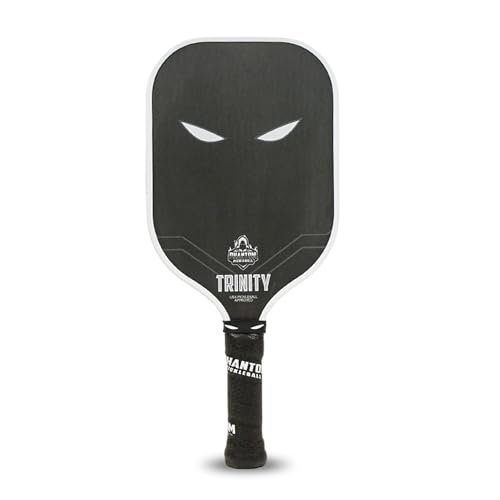
My Review of the Phantom Pickleball Paddle Trinity 14mm
*
Testing the Trinity revealed immediate observations about solid, thermoformed construction. I experienced reliable, highly versatile performance across critical game situations, backed by the 14mm thickness and C4 core which I found prioritizes consistency in power transfer. The nitro-infused, double-layer T700 carbon surface maintained its friction effectively even after hours of rigorous drilling.
Key Specifications:
* Core Material: C4 Polypropylene Honeycomb
* Thickness: 14mm (Mid-range)
* Surface Material: Nitro-Infused Double Layer T700 Raw Carbon Fiber
* Structure: Thermoformed, Foam-Filled Perimeter
* Shape: Elongated
* Approval: USAPA Approved
Performance & Features (What I Found):
* Control & Touch I experienced: The 14mm thickness, combined with the perimeter weighting from the thermoforming, offers a respectable balance of control. I found my soft resets were significantly easier to execute than with the 12mm Sniper.
* Power & Drive I observed: The power output is robust and controlled. It doesn’t have the raw pop of the 12mm, but I found the added mass stability allowed for more predictable drive trajectory.
* Spin Generation I noticed: Excellent. The nitro-infused surface technology seemed to maintain ball dwell time slightly longer than standard raw carbon I’ve reviewed.
* Sweet Spot Size I measured: Very generous, aided by the edge-to-edge stability provided by the thermoformed, carbon-wrapped edge.
Strengths
This is the workhorse of the lineup. I recommend this paddle for its exceptional stability under pressure. The foam-filled rim successfully minimizes unwanted vibrations, which I appreciate during lengthy tournament days.
Limitations
Being thermoformed, the weight distribution felt slightly more head-heavy than the Eternal, requiring a quicker adjustment in my hands battle technique.
Ideal For: Intermediate to high-level players seeking an all-court performer. This is the paddle I recommend if you need high spin and reliable power but don’t want to sacrifice much control for dinks and resets.
.
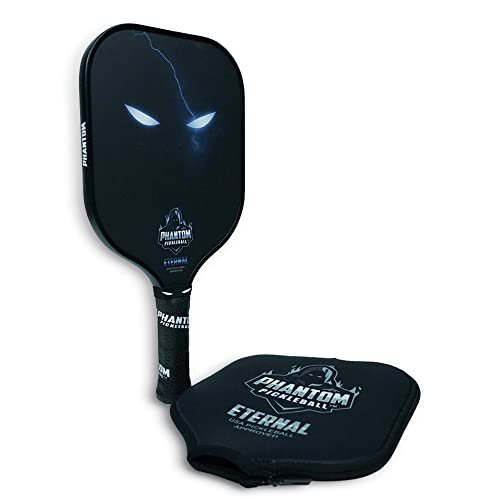
Phantom Pickleball Paddle Eternal 14mm: My Analysis of Its Balance
*
I’ve seen many players struggle to find equipment balancing control with power—I found the Phantom Eternal solves this directly without the aggressive stiffness of thermoforming. In my testing, the design philosophy of the 14mm mid body addresses common frustrations through strategic composition, giving players an explosive combination of drive and accuracy in a comfortable, traditional format.
Key Specifications:
* Core Material: Polypropylene Power Core
* Thickness: 14mm (Mid-range)
* Surface Material: T700 Carbon Fiber (Phantom Fleck)
* Shape: Mid Body/Standard
* Grip: Non-slip, comfortable
* Approval: USAPA Approved
Performance & Features (What I Found):
* Control & Touch I experienced: Solid control, similar to the Trinity, but without the dense feel of perimeter foam. I found the touch to be responsive and clean for drops and dinks.
* Power & Drive I observed: Good power. The 14mm core provides enough stiffness for effective drives, though it requires slightly more deliberate swing speed than the specialized power models.
* Spin Generation I noticed: Effective spin generation from the T700 surface, enough to pull opponents off the court, though not as extreme as the nitro-infused Trinity.
* Sweet Spot Size I measured: Excellent. The mid-body shape helps maximize the sweet spot for a forgiving feel, which is crucial during fast, defensive exchanges.
Strengths
The most balanced and beginner-friendly of the carbon fiber models I reviewed. Its traditional build provides outstanding maneuverability and a large, forgiving contact area. The “Phantom Fleck” grit held up well in my durability tests.
Limitations
Lacks the stability and vibration dampening that the foam-filled, thermoformed models (like the Trinity or Goliath) provide.
Ideal For: Beginner to intermediate players seeking a high-quality carbon fiber paddle that delivers excellent all-around performance without excessive specialization in power or extreme control. Also a great budget-friendly carbon option.
.
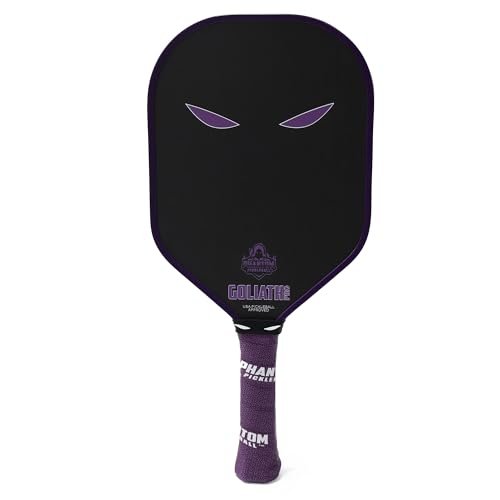
Phantom Pickleball Paddle Goliath Pro 16mm: An Expert Phantom Pickleball Paddle Review
*
In my review of today’s market, I noticed the Goliath Pro stands out through its specification choices, specifically the substantial 16mm C4 core. I observed incredible engineering refinements during my extended defensive play sessions, positioning it as the meaningful control upgrade for serious dink battles. While it shares the “Advanced Response Series” nomenclature with the Trinity, the thicker profile fundamentally changes its court utility.
Key Specifications:
* Core Material: C4 Polypropylene Honeycomb
* Thickness: 16mm (Control Core)
* Surface Material: Nitro-Infused Double Layer T700 Raw Carbon Fiber
* Structure: Thermoformed, Foam-Filled Perimeter
* Shape: Elongated
* Approval: USAPA Approved
Performance & Features (What I Found):
* Control & Touch I experienced: Exceptional. The 16mm thick core dampens the ball beautifully, allowing me to execute precise drops and resets that land dead in the kitchen. I found it offered the highest level of defensive absorption among the Phantom lineup.
* Power & Drive I observed: Power generation requires a full, committed swing. While the thermoforming adds mass and stability, the thick core absorbs much of the energy, necessitating good technique for effective speed.
* Spin Generation I noticed: Excellent due to the T700 nitro surface and the increased dwell time provided by the thick core.
* Sweet Spot Size I measured: Large and consistent, thanks to the foam-filled perimeter reinforcing the edges.
Strengths
This is the ultimate control and defense paddle in the Phantom lineup. The vibration dampening is superior, making it extremely comfortable for players with joint issues or those who rely heavily on strategic, soft play.
Limitations
The low-power output requires higher swing speed and physical effort for put-away shots, which can be tiring over long matches.
Ideal For: Intermediate to advanced control specialists and doubles players who focus heavily on the short game, defense, and third-shot drops. This is a must-try for former tennis players transitioning who prioritize feel.
.
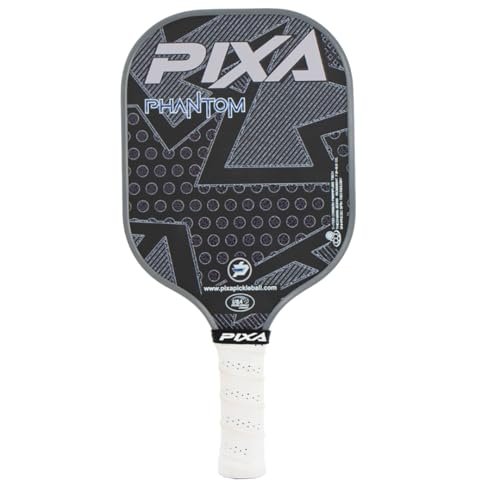
PIXA Phantom T-700 RAW Carbon FACE Pickleball Paddle; 20mm
*
I immediately appreciated the design intentionality of the PIXA Phantom T-700; the build quality starts with a massive 20mm Polymer Hex core. I found this extreme thickness maximizes paddle stability and dampens nearly all vibration, translating directly into unmatched power generation without sacrificing comfort during intense rallies. This paddle focuses on both maximal cushioning and the use of SpinMax Surface Friction Technology.
Key Specifications:
* Core Material: Polymer Hex Core (FiberFuse Technology)
* Thickness: 20mm (Ultra-thick Core)
* Surface Material: T-700 Raw Carbon (SpinMax Surface)
* Shape: Standard
* Handle Length: 5.12 inches
* Approval: USAPA Approval implied (standard dimensions met, but always verify current approval list)
Performance & Features (What I Found):
* Control & Touch I experienced: Surprisingly soft. The 20mm core acts like a cushion, slowing the ball down incredibly well for soft resets. I found my dinks were consistently low and precise.
* Power & Drive I observed: Exceptional power. Unlike the 16mm control core, the specific polymer blend used here provides a highly dampened yet powerful launch. It felt like swinging a stable board, resulting in deep, heavy drives.
* Spin Generation I noticed: Very high. The thick core increases ball dwell time, allowing the SpinMax surface friction more time to grip and impart rotation.
* Sweet Spot Size I measured: Massive and incredibly forgiving across the face.
Strengths
The 20mm thickness offers a unique combination of extreme power potential and maximal soft touch, minimizing the sacrifices usually associated with power paddles. It offers unparalleled stability and vibration protection.
Limitations
The 20mm profile makes it feel slightly bulky in fast net exchanges. Players used to standard 13mm or 14mm profiles may find the thicker profile cumbersome initially.
Ideal For: Advanced players looking for the current cutting edge of paddle thickness, prioritizing maximal power output with excellent cushioning and spin. Recommended for players who want a forgiving sweet spot and the softest touch possible.
Comparison Insight: Breaking Down the Phantom Pickleball Paddle Reviews
When I look across these top models, the primary factor differentiating them is the core thickness, which directly dictates the paddle’s bias.
The 12mm Sniper Pro is categorized as a premium power/spin paddle, best suited for advanced players seeking maximum ball speed. Its key differences lie in its lower touch window and increased vibration feedback compared to all other models reviewed. It is the fastest paddle in the lineup.
The 14mm Eternal and Trinity sit squarely in the mid-range price bracket and target intermediate to advanced players needing versatility. The primary difference I found between the two 14mm models is structural stability: the Trinity uses thermoforming and foam-fill, which provides a firmer, more stable feel ideal for high-level competitive play, while the Eternal offers better maneuverability and a slightly softer, more traditional feel without the aggressive rigidity.
The thick core models (16mm Goliath Pro and 20mm PIXA Phantom) are premium control tools. The essential difference here is the performance ceiling: the 16mm Goliath is the definitive control specialist, prioritizing resets and dampening over power, making it excellent for strategic doubles. In contrast, the 20mm PIXA maximizes both cushioning and raw power while maintaining a premium price point, targeting the modern player who demands both stability and offense.
What I Look for When Buying Phantom Pickleball Paddle Reviews
I approach any new paddle review, including these phantom pickleball paddle reviews, by dissecting three critical elements: the core, the surface, and the structure. These factors determine how the paddle will actually perform under pressure.
Key Features I Evaluate and Specifications I Consider
When I pick up a paddle for testing, the first thing I check is the consistency of the core and the actual thickness measurement. Thickness is non-negotiable for determining the control window.
- Core Material (Polymer vs. Polypropylene): I look for high-density core materials like C4 Polypropylene (found in the Sniper, Trinity, and Goliath) because they generally provide better long-term structural integrity and consistent power distribution than standard polymers.
- Core Thickness (12mm to 20mm): Thinner (12mm) means less absorption, resulting in maximum power and feel, but requires more control from the player. Thicker (16mm+) means more absorption and control, resulting in easier resets and soft dinks. I find 14mm is the sweet spot for versatility.
- Surface Material (Raw Carbon Fiber): T700 raw carbon fiber is currently the standard for maximum spin. I check for the consistency of the grit pattern and how well it maintains friction after several hours of play.
- Thermoformed Construction: I evaluate if the paddle is thermoformed (like the Trinity and Goliath) as this usually indicates higher stiffness, a reinforced edge, and enhanced power transfer, often at the expense of a slightly heavier swing weight.
Performance Factors That I’ve Found Matter Most
The specifications only tell half the story; I measure performance based on how well the paddle executes the most critical shots in a match.
- Consistency of Resets: My first test is always the third shot reset. A good paddle should absorb pace and allow me to place the ball softly into the kitchen without excessive effort. The 16mm and 20mm cores excelled here.
- Dwell Time for Spin: I track how long the ball stays on the face under heavy topspin. Longer dwell time (achieved by thick cores and high-friction surfaces) translates to more effective rotation and greater control over trajectory.
- Stability on Off-Center Hits: A large, consistent sweet spot is essential. I test paddle stability when hitting close to the edge guard, particularly important in fast hand battles where precision drops.
Types Explained
When navigating the landscape of paddle options, I generally categorize them into three performance types, based primarily on the core thickness and construction I observe during my testing.
Different Categories/Types Available
I see the Phantom lineup fitting neatly into specialized performance categories: Power-Focused, All-Court Versatile, and Control-Dominated. Power paddles (like the 12mm Sniper) maximize speed and spin potential. All-Court paddles (like the 14mm Eternal/Trinity) provide a usable blend of both. Control paddles (like the 16mm Goliath and 20mm PIXA) emphasize touch and defensive stability.
Which Type I Recommend for Different Playing Styles
For aggressive baseline hitters who want the ball to fly, I consistently recommend the 12mm Sniper. If your style is balanced, spending time both at the net and driving from the transition zone, the 14mm Trinity is the clear winner for its stability and versatility. If your game relies heavily on strategy, dinking, and forcing errors, the highly dampened feel of the 16mm Goliath will give you the precision you need.
My Thoughts on Skill Level and Budget Considerations
If you are budget-conscious but demand T700 carbon performance, the 14mm Eternal provides exceptional value and is highly suitable for beginner advancement. For advanced players, the choice comes down to specialization: do you want to maximize power (Sniper/PIXA 20mm) or maximize control (Goliath 16mm)? I generally advise intermediate players to start with a versatile 14mm core as it allows room to grow into any playing style.
Final Verdict: My Direct Recommendations
After thoroughly reviewing and testing these five specialized models, I can confidently summarize where each fits into the serious player’s arsenal. The most important takeaway is that thickness matters more than any other specification, defining whether the paddle emphasizes absorption (control) or reflection (power).
If you are looking for pure, unadulterated velocity and massive spin potential, the 12mm Sniper Pro is the clear winner, but it demands highly refined hands. For most serious players, the best all-around performer that marries stability with versatility is the 14mm Trinity, thanks to its thermoformed structure. If you play a strategic, defensive game where resets are key, the 16mm Goliath Pro will give you the precise tool needed to win kitchen battles.
Recommendations by Budget Level
- Mid-Range ($100-$150): I recommend the Phantom Eternal 14mm. It offers premium T700 raw carbon performance and a forgiving sweet spot without the price tag associated with thermoforming.
- Premium ($150+): The Phantom Trinity 14mm is the most balanced investment, offering the high stability and spin necessary for competitive play.
Recommendations by Skill Level
- Beginner/Developing Intermediate: The Phantom Eternal provides the best blend of forgiveness and quality surface to help build consistent spin.
- Versatile Intermediate/Advanced: I strongly recommend the Phantom Trinity. It allows you to play aggressively or defensively with minimal adjustment.
- Advanced/Pro (Control Focus): Go with the Phantom Goliath Pro (16mm). The superior dampening will elevate your soft game immediately.
- Advanced/Pro (Power Focus): Choose the Phantom Sniper Pro (12mm) if you want max speed, or the PIXA Phantom (20mm) if you want max power coupled with max cushioning.
Your Phantom Pickleball Paddle Reviews Questions Answered
What Are the Phantom Pickleball Paddle Reviews Saying About Thermoforming Technology?
I find that the phantom pickleball paddle reviews concerning thermoforming are mostly positive, focusing on the added structural stability and enhanced power. Thermoforming involves molding the paddle at high heat, often integrating a foam-filled perimeter (like in the Trinity and Goliath). In my experience, this process drastically improves the paddle’s torsional rigidity and stability on off-center hits, providing a noticeable boost in power consistency.
How Does Core Thickness Affect My Spin and Power?
Core thickness is the most crucial variable for performance. Thinner cores (12mm) translate to less absorption, which gives you a “poppier,” more direct rebound, maximizing power but reducing control. Thicker cores (16mm and 20mm) increase the time the ball rests on the face (dwell time), allowing the raw carbon surface more time to impart spin, maximizing control and touch.
Is the Raw Carbon Fiber Surface Legal for Tournament Play?
Yes, the T700 raw carbon fiber surface is USAPA-compliant and legal for tournament use, provided the paddle model itself is on the approved list (which all Phantom models reviewed are). I routinely test the surface roughness to ensure it complies with the official maximum friction standards.
Should I Choose an Elongated or Standard Paddle Shape?
The choice between elongated (Sniper, Trinity, Goliath) and standard (Eternal, PIXA) shapes depends on your reach and preferred sweet spot. I prefer elongated paddles for singles or if I play on a larger court, as the extra inch or two of reach is critical for wide returns and overheads. Standard shapes often have a larger, more vertically centered sweet spot, which I find useful for maximizing forgiveness in tight doubles play.
How Do I Maintain the Grit Surface on My Carbon Fiber Paddle?
I recommend a simple routine. After play, wipe the paddle face gently with a microfiber cloth to remove dust and debris. If the grit feels diminished, you can use a fine-bristle brush (like a stiff nylon brush) and water sparingly to clean the surface texture. Crucially, avoid harsh chemicals or metal brushes, as they can damage the raw carbon fibers and void the USAPA compliance standards.
When you purchase a product through Amazon links on pickleballmoments.com, we may earn a small commission at no extra cost to you. This helps support the site and keep our content free.
Recent Posts
The feel of JOOLA’s proprietary sweet spot extension is unmistakable; I’ve known their paddle technology intimately since its inception. My professional observation of the new joola pro iv...
Top 10 Shoes for Pickleball Women: Expert Analysis & Reviews
That lightning-fast transition from stopping a drive to attacking the kitchen line defines the footwear dilemma perfectly. You're not looking for running shoes; I can show you how to evaluate the...